Showing posts with label Luaniua Life. Show all posts

Thursday, January 26, 2012

Evening Prayer

Luaniua's Anglican church sits in the center of the village.  Its whitewashed, cinder block walls rise only four feet, leaving the sides open to the ocean breeze.  It really is more of a pavilion than a church, except that at the front there is a raised dais with the alter, preaching podium, candle stands, and seats for the priest and catechists to sit.

Every sunrise and sunset the catechist rings the bell that hangs from the eves, summoning the faithful.  The church's 'bell' is really just a hollow, rusty propane cylinder, but it serves the same purpose.  When struck with a hammer, it echoes as far as the island's sandy tip.

I used to go to the evening service every night.  Our house stood just opposite the church, so my walk was a short one, past the carefully tended bushes that ringed the pavilion.  The old man who cared for the building kept the flowers meticulously trimmed, and at sundown every night they opened tiny, trumpet-shaped petals to release their soft sweetness into the air.

It was through this lingering incense I walked, prayer book in hand, to take my place on the woman's side of the church.  The sides were strictly divided by sex, with the women on the left and the men on the right.  Children sat at the very front, their little butts squirming on the worn, 1 x 8 benches.  Behind them were the teenagers, with adults at the very back of the church.

The village catechist ran the weeknight services.  They were always the same, read with comforting predictability from the Melanesian Anglican Prayer Book.  Opening song.  Liturgy.  Sing the Magnificat.  Scripture readings.  More singing.  Prayers.  Benediction.  Dismissed.

The very last prayer, read as the sky purpled and the first star appeared, was a hushed request to the unseen God.
Shine on our darkness, we pray you, Lord, and by your great mercies keep us from all troubles and dangers of this night, through Jesus Christ our Lord.  Amen.

Tuesday, September 6, 2011

Awakening to the Day

I woke up this morning to this status update on my newsfeed:
gratitude list:  my children, their great schools and teachers, our home smelling of back-to-school blueberry muffins, my hubby's hard work, my savior-jesus, health, espresso, water to drink, knowing gods word is true, work, friends and sleep with dreams.
For some reason (maybe the mention of espresso, blueberry muffins, and dreams?), this brought to mind morning time on Luaniua.

I would wake every morning to the shake-shake-shake of our house, rocking on its stilts as the family started to stir.  Mom coming from the rain tank outside with a pot of water, heading towards the single Bunsen burner where she did all her cooking.  The subsequent click, click, click, wooooosh as it caught flame.

It was up to us to get our business done before Mom had breakfast on the table.  The day would officially start after we had all gathered around the Formica-covered plywood that was bolted to the wall of our veranda on hinges, raised during the day to save room.  The veranda, running across the front of the house, was barely 8 feet wide.  At breakfast and dinner, we unlatched the table from the wall, lowered it on its hinges, and clustered around it on canvas chairs and stools made from upturned buckets.


I crawled down the ladder of my loft, and headed out the door to take care of my 'morning business'.  The sun was just peeking through the coconut trees, rising into a sky that was already so deep you could get lost in it.  There were rustlings from the hut next to ours.  A sleepy baby cried before being put to breast.  Chickens were scratching in the gravel path.  Smoke was filtering through the thatched roofs of the huts, the air heavy with the scent of morning cook fires and dew.

I traveled down the familiar path to the beach, relishing as I did every time the moment of breakthrough when the last stand of trees parted and the ocean lay before me.  Cool still from the night, a soft breeze swept off the water to greet me, its clean, salty scent awakening my senses to the day.

Saturday, September 3, 2011

A Very, Very, Very Fine House

The first sound on the periphery of my awareness was the fussing of a rooster.  Its preemptive squawking was accompanied by a chorus of clucking and beating wings.  I opened my eyes.  The assaulting sun pin pricked a diamond pattern through the filtering mat wall at the foot of my bed.  Three feet from me, my sister was a huddled mound on her loft bed.

The bedroom we shared, a scant 9 feet by 9 feet square, also doubled as our home's library and pantry.  Anna and I each had our own loft bed, built three feet apart into opposite walls and elevated to fit a desk and a storage crate under each, with a foam sleeping pad on top.  This was where I did my school work, and kept my clothing and personal things.  I had glued some little erasers a supporter in the States had sent us in a row along the 2x4 beam that served double duty as wall frame and shelf for my desk.  The little rubber rainbows and unicorns kept me company as I worked on long division and adverbs.

The wall that didn't have my sister's and my beds against it was delegated to our significant book collection. Picture books filled the bottom three lumber shelves, followed by four shelves of paperback novels.  This treasure trove was right at the foot of my bed.  Every morning, L.M. Montgomery, Madeline L'Engle, Louisa May Alcott, Laura Ingalls Wilder, Daniel Defoe, Jean Craighead George, Gary Paulson, along with scores of others, would greet me like so many old friends.  I considered myself lucky to have 'the bed with the library'.  My sister's ladder abutted the food safe, a screened box where we kept our leftovers.


The interior mat walls in our house rose only 9 feet, with boxes of canned goods and supplies stacked on the shelves running across the top of them.  Here was everything we would need over the six months we stayed in the village.  As the months drew out, the piles of boxes next to the roof dwindled, until finally the ship arrived at the island to carry us back to Honiara.  Christmas and birthday presents were hid here too, bought months in advance and smuggled out to the village.  For this reason, we weren't allowed to climb up to the rafters and explore the shelves.

Sometimes we did, anyway.  We had a game resembling 'tag', where we would chase each other around the house.  The only rule was you couldn't put your feet on the floor.  Up and over walls we would climb, spider-walking from one beam to the next.  The entire house would sway on its stilts until Mom got back from the beach and put a stop to it.

Tuesday, August 9, 2011

The Difference Is ...

There was an albino woman who lived in our village.  Her skin was a painful shade of hot pink, wrinkled and lined like dry leather.  Her pale, bloodshot eyes were hooded in a constant squint against the sun's blinding glare.

I am ashamed to say that I avoided her.  She was a reminder of what I was - an outsider, different, marked by the color of my skin.

The kids used to tease me occasionally about her.

"Danica, I saw your mom at the well today."

"Really?  I didn't know she went ... "

"No, your island mom."  At which they'd burst in to riotous laughter and shove against my arms.  Ha ha.

Life is cruel for someone marked with a physical disability.  It is ten times more cruel if that person lives in the third world.  I have seen a boy with Down Syndrome squatting naked in the dirt as he picks grains of rice from it to eat.  A hermaphrodite pursued relentlessly by jeering boys.  A girl with a wandering eye named, "Bent Eye".

We like to think we are more civilized here in the West.  But in reality all our hearts hide a revulsion of those different from us.  Christians ostracize gays and Muslims.  Republicans revile Democrats, and both sides ridicule the Tea Party.  Northerners feel superior to Southerners.  The poor hate the rich.  Whites marginalize Blacks who marginalize Hispanics who marginalize Whites.

And we're all bumping around in this crazy world feeding fear with hate while the suffering continues and nothing gets solved.

Sunday, July 24, 2011

Nekkid

One of the things I never quite got over in the village, even though we lived there for a little under a decade, was the nudity.  

Little boys running by in packs with their tallywackers flopping proudly would make me cringe a little on the inside, every time.  As they squatted in the dirt to pick up some stick or stone, I would covertly watch as their junk hung lower ... and lower ... but never quite grazed the ground.  Once I saw a toddler heading across the soccer field, letting lose a stream that watered the ground in front of him like a sprinkler as he ran.  

I always tried not to stare.  But when a nekkid boy (no matter how young), is in front of you, your eyes aren't drawn to his face.  Trust me.  

Thursday, July 21, 2011

Water Spout

I heard the drum as I was fetching back water from the village rain tanks.  From the lagoon side of the island came shouting, and the quick steady thump of a stick on an upturned 5 gallon bucket.  Some kids playing at the island version of jacks under a nearby tree dropped their pebbles and headed towards the commotion.  Curious, I left my bottles at the foot of our front stairs and joined the flow of people towards the lagoon. 

When I emerged from the close sitting huts, I found half the village gathered at the tide line, looking out across the still water.  Two more had joined the solitary drum now, and a woman a few huts down hauled a sheet of corrugated roofing onto the open sand and began to beat on it. 

"What's going on?"  I asked the closest pikini.  She picked at her belly button for a minute, standing stork legged in the sand, then pointed with her free hand out into the lagoon. 

Following her finger, I saw what had captured the village's attention.  There were four water spouts dancing across the glossy water.  Fascinated, I watched as the long columns of water snaked slowly towards land, undulating with a fierce, powerful grace. 

"But why are people beating the drums?"  I asked, confused. 

The girl looked at me with wide eyes, and I realized for the first time that she was afraid.  "Because the noise scares away the evil spirits," she answered.  By now, women all up and down the beach were beating on upturned buckets, logs, and sheet metal, clapping sticks together, and generally making noise with anything they could. 

One of the water spouts had broken away from the rest and made land several hundred yards from the village.  Now the drumming became frantic, and I heard a few people chanting prayers from the old island religion.  "Go away, spirits.  Don't come to this village." 

Suddenly cries broke out from people up the beach, and I strained to see what was happening.  "Daviti!"  I heard someone shout.  It was the way the islanders said my father's name. 

I looked and saw my dad walking up the beach, towards the water spout.  The villagers all clumped together where the huts ended, but Dad kept walking across the empty expanse of sand.  The murmurings grew increasingly fearful as he headed straight towards the swirling wind, which had now morphed into a dust devil on dry land. 

He approached it, his lava lava flapping back against his legs, seeming to shrink as he neared the towering whirlwind.  And still he went on.  And the drums beat an inexorable rhythm.  Until at last he reached the swirling column of sand and debris.  The village held a collective breath as my father stepped into the whirlwind. 

And suddenly it was gone.  Vanished in a trembling moment when it seemed the very foundations of the island shook. 

Tuesday, June 28, 2011

Fire in the Village

"Fire!"

The cry rose up from the heart of the village.  In a place where every roof was constructed out of thatched leaves, and every wall was woven of coconut fronds, uncontained fire was a deadly thing.  Countless open cook fires and smokey 'mosquito' fires dotted the village, kerosene lanterns illuminated us by night, and we kids often played 'flick the match' as we walked through the houses (hold a match, sulfur side down, on the striking strip.  Flick with your finger and watch as it goes spinning away, a little flame somersaulting through the air).  And yet, there hadn't been a threat of fire to the village since we'd arrived.

But now, hungry flames were licking at the shaggy brown roof of a nearby hut.  They were just at the bottom, where the long, thin pandanas leaves hung in so many points off the low eves of the hut.  The fire was quickly gaining speed, leaping with increasing voracity up the roof's steep slope.  A few minutes more, and the entire hut would be ablaze.  And then the flames would go racing from roof to roof, turning the entire village into a merry bonfire of destruction.

Men and women materialized out of nowhere, buckets in hand.  By this point, we'd been at Luniaua for several years, and this was the first fire I'd witnessed there.  Even so, the villagers mobilized as if they did fire drills every day of their lives.  In the time span it took me to get out my front door and positioned in the yard for a better view, there had formed a long human chain from the lagoon to the burning house.  The villagers passed bucket after bucket of seawater, dousing the fire, wetting the surrounding leaves and soaking the neighboring roofs.

And as quick as that, it was done.  Almost before it had begun, the fire was put put out.  Vanquished.  Only a few square feet of the roof had been taken by the flames.

Everyone stood around long enough to gossip over the start of the fire (a teenager taking a burning coal from the house's fire to the cooking hut), and share a roll-your-own cigarette.  Then, the crowd dissipated back into the village, each returning to his or her previous task.  And I was left thanking God for the villagers' community mindset, which allowed them to meld so quickly together as a unified, solid force in the time of need.

Friday, June 17, 2011

A Nighttime Ramble

The night sky draped darkly over the island.  Cooking fires had long since burned down to one or two smoldering coconut husks.  A fingernail moon pinned the black canopy in place, accompanied by a million stars.  I had slipped from my bed, driven out into the night by some hungry, restless need.  Wrapping only a thin lava lava around myself, I escaped our house and the quiet sleeping sounds of my family.  The night welcomed me as its own.

The coconut fronds overhead rattled knowingly as my feet took the familiar path to the sea.  Quiet as a shadow, I passed our neighbor's hut.  A few chickens scolded sleepily.  I heard somebody roll over, their rustle, rustle, snort filtering thinly through the mat wall.  Now I had passed their little cooking hut, and my path took me through a small patch of untamed bush.  This was where the old hale aiku had stood, where the islanders had worshiped their ancestral gods.  Although it was in the center of the village, nobody had built on it.  The ground was still sacred, in spite of the cinder block Anglican church erected beside it.

Finally, I cleared the village and stepped out onto the beach.  Even on this dark night, the sand shone whitely.  The waves beyond undulated to blot out the stars in dark, oily mounds. I was the only soul alive in this midnight land.  

Slowly, I raised my arms in welcome to the cool sea breeze.  And for a moment, as it lifted my hair from my sticky neck and tangled my lava lava around my legs, I forgot myself in the wonder of it all.

Sunday, May 29, 2011

Taking Out the Trash

It's an unsavory job wherever you live.  On Luaniua, the trash gets sorted into burnables, which are incinerated on the beach, and food waste, which is fed to the chickens and pigs.  Everything that can't be safely burned or fed to the animals gets taken far out onto the reef at low tide for the ocean to flush away. 
This was mostly my brother's job.  Nathan would sneak through the village after dark with a bucket of tin cans, plastic, dried pens, empty toothpaste tubes, and foil packets, and then pick his way out to the yawning edge of the reef.  Why wait for the sun to set?  Because otherwise he'd collect a bevy of curious pikininis, who would pick through our trash, and then broadcast it throughout the village.  Even our garbage was endlessly interesting to villagers who had basically lived the same life for centuries. 

Sometimes, he would catch the tide on the way in, or dump too close to the beach.  I always knew when this had happened, because the next morning there would be a week's worth of white man trash floating along the shore.  The sodden re fried bean packets and jagged tomato cans always gave me a guilty, uneasy feeling.  When you throw away trash, you want it to stay thrown away.  You don't want to be reminded of the ghosts of things you've consumed. 

There are people in my life with whom I share a history of hurt.  When I don't interact with them, I'm fine.  The trash stays out on the reef where it belongs.  But then something happens to trigger conflict, and suddenly the tide comes rushing in and I'm staring at the sodden mess of old things.  Nasty old words and hurts that can't be burned away.  And I have this boiling, seething mess of garbage I have to look at again.  Forgive again. 

I used to think that once I forgive a hurt, it gets washed out to sea.  I don't ever have to look at it again.  But I've learned that sometimes, I have to chose to forgive the same offense over and over again, because it resurrects itself in my heart whenever trouble rolls in. 

All I know to do is look at each bit of trash as it floats by, and say to myself, "Yep.  That hurt.  But I forgive."

Friday, April 29, 2011

Marriage, Island Style

Tell your father that we're getting married.

Um.  What?  The words prickled my skin like a centipede's legs.  Unable to suppress a shudder, I let the letter fall on the happy yellow quilt that lit up my uniformly boring dorm room.  The letter, postmarked 'Honiara, Solomon Islands', had been forwarded to me by my parents my freshman year of college.  I opened it happily, wondering which of my girlfriends 'back home' had taken the time to write.  To my great dismay it had been sent by one of the boys who had run in my circle.  Apparently this was his romantic proposal.  Island style.

When a boy and a girl get married on the island, it is only after extensive negotiations between both families.  The girl takes with her a dowry of thick beaded belts, cloths died bright yellow with turmeric, bolts of calico and sometimes money.  The boy's family pays for the girl with a mountain of coconuts, and sometimes a pig or two.  With the girl also comes land, which follows the matriarchal line in that culture.

After a thorough reciting of the Anglican Book of Common Prayer's Marriage Ceremony (with its fair share of have mercy's), the happy bride is led, sobbing with her face in her cheap Thai wedding dress, to the marriage feast.  It is a requisite that the bride cries throughout the entire feast.  She sits there, shoulders shaking, head buried in a lava lava, sniffling, next to her new groom.  They occupy the mat of honor, front and center in the semi-circle of gathered revelers.  The groom maintains an appropriately solemn and embarrassed expression.  Neither makes eye contact with each other, or anybody else.

It was explained to us that the bride cries for her lost girlhood, her single friends, and single sisters.  Once she crosses the threshold of womanhood, she enters the completely different world of the married woman. In this highly segmented society with its complex social structures, this is a huge and lasting change.

Everybody else thoroughly enjoys the festivities.  Hot and cranky after the stifling church service, everybody piles joyfully onto the assembled coconut mats, and hungrily eye, as one body, the mounds of food.  There is taro pudding cut into brown, gelatinous cubes.  Tubs of little round fry bread.  Fish cooked in coconut milk, clams cooked in coconut milk, crabs cooked in coconut milk, taro cooked in coconut milk, rice cooked in coconut milk.  If the family is wealthy, there might even be a pig or two, slaughtered as its screams echoed through the village the day before, and now cut into sumptuous little chunks and cooked up.  In coconut milk.  Blackened kettles of hot tea stand ready, and to the side is a mountain of green coconuts.

The guests, having brought their plates, mugs and spoons, settle in.  The bride's father stands up.  The bride resumes sobbing a little louder.

"Thank you, everybody, for coming today.  Chief Kanaka, Chief Kevaa (Insert names of all the chiefs, chief's sons, priest, local government officials.  All the 'big men' are recognized personally.)  We are glad that you came to our little feast today.  I am so sorry that it is so bad.  There really isn't any food.  We were not able to prepare much for you today.  I deeply apologize for this horrible food that we are about to serve you.  It really is quite bad, and we are ashamed of its ineptitude."

This is the politest thing a host can say, since arrogance is next to murder on the island sin scale.  A quick prayer is then offered up, and the women of the family commence with divvying up the delicacies.  Everybody eats while all the big men stand up and make boring speeches, then relax with tea as groups of kids parade out to dance to steady, faithful drumbeats.

As the party starts to wear itself out, guests file past the happy couple, depositing tokens on the mat in front of them.  The bride, reduced to sniffles by this time, cranks it up for the finale.

Finally, the feast is completely over.  Guests leave with plates of food.  The men retire to a relative's house and get rip roaring drunk.  The women wash the pots and pans out, gossip, and smoke their hand rolled cigarettes.  And the happy couple disappears for a while from village life, only to return fat, pregnant, and thoroughly settled into their new roles.

Friday, April 15, 2011

The Green Ones Taste the Best

Ship days were always exciting.  Communications on the short wave would inform us of the government freighter's imminent arrival.  News would spread through the village, hopping hut to hut like lice on the heads of siblings.  Excitement would crackle, underlying everything with a subtle exclamation mark.  Smoke filtered free from thatched roofs.  The ship's coming!  A girl pulled water up from the well.  The ship's coming!  A teenager thwacked coconut husks open on a sharpened spike.  The ship's coming!  Men traded drags on a hand rolled cigarette.  The ship's coming!


Every kid who didn't have duties at home (and many who did, but shirked them off) congregated on the ocean side of the island, straining for the first sighting on the horizon.  It would appear as a tiny black dot, minuscule, barely distinguishable against the blue.  As soon as it was certain that it was indeed the ship, runners would sprint in gaggles through the village.  "Keva'a!  Keva'a!  (Ship!  Ship!)"  they would shout.

It was joyful news.  The ship brought loved ones long unseen, supplies, fresh produce that would soon be eaten.  For us, it meant mail, food and other supplies sent by our SITAG support, and sometimes, if we were lucky, there would be a package from home.


Every so often, a church group or maybe family member would get together a care package for us and send it, filled with goodies, half way around the world.  These were rarities (we got about three per year), and greatly coveted.  You never knew what treasures the brown cardboard box would be hiding.  Fajita spices.  Kool-Aid.  Stickers.  Dollar store erasers and pencils.  Travel size shampoos.  Wrigley's gum.  But if we were really lucky, there would be candy.

Real, American candy.  And best of all, a mega pack of M&M's.

I am not ashamed to say that we were intensely covetous of those M&M's.  To prevent WWIII from erupting in our hut every time the ship came in, we had a system to distribute treats.  We were fair.  Maniacally fair.  So fair we were probably diagnosable.

We would all sit around the family table, and watch with eagle like scrutiny as Mom or Dad divvied up the candies.  Literally, it would go by color.  One brown for Nathan.  One brown for Danica.  One brown for Anna.  One brown for Matthew.  One yellow for Nathan.  One yellow for Danica.  And so on, until we all had little piles of the exact same number of the exact same color of M&M's.  Because you know each color of M&M tastes different.

And then, we'd all four of us sit for a delicious moment, taking in the bounty, before dealing with it in our own ways.  Nathan took his to share with a few select friends (who always knew, by the way, to hang out underneath our house when the ship was unloaded).  Matthew would eat his in one fell swoop.  Anna hoarded hers, keeping them almost until they lost their color, and using them as collateral in our sundry sibling wheeling and dealings.  I would eat mine, one by one, keeping the colors even, in order, starting with my least favorite:  Brown.  Orange.  Red.  Blue.  Yellow ... Green.

I would always eat the green M&M last in the cycle.  Because the green ones taste the best.

Saturday, March 19, 2011

The Cover Up

One result of living on an island is that almost everything gets cooked in coconut milk.  Pretty much anything tastes better when saturated with the fatty, creamy white goo squeezed from grated coconut meat.  My favorite was when they cooked it in rice.  When rice is cooked in coconut milk, it turns into a lovely, gelatinous, sweet pudding, thick and chewy.

Sometimes, the islanders would weave little hand-size, diamond shaped containers out of coconut leaves and fill them with rice.  The rice containers would then be boiled in coconut milk, and in the end, when you unwrap the coconut leaves, you get a little diamond of rice pudding.  Rice to-go, island style.


One time I joined some friends on a voyage to some of Ontong Java Atoll's outer islands.  The women had packed the front of the fiberglass canoe full of food for the trip.  Taro pudding (the color and consistency of poo), fish dried over the fire, green coconuts for drinking.  And best of all, a basket full of little packets of rice.  I eyed those packets the minute they were loaded, and my mouth instantly started watering. 

Out we headed, over the open lagoon.  Cranked up to max horsepower, the little outboard motor on our canoe propelled us across the short, choppy waves.  A rush of exhilarating speed came as the wind swooped into our ears and hair and clothing.  The sun glinted sharply off the water.  We passed swirling flocks of sea birds dive bombing schools of fish below the surface.  The open ocean lay below, the sky spread above, and we were joyful inhabitants of a greater world. 


But with all the swirling of colors, light and exuberant movement around me, all I could think about was the little rice packets in the front of the boat.  I wanted one.  I wanted one bad.  I wanted to bite into the sweet, chewy goodness and lick coconut syrup off my fingers. 

I soon had my chance to ask for one.  One of the canoes in our fleet had something wrong with its outboard motor, and we all stopped in a little cluster.  The lagoon stretched deep, dark and blue beneath and around us.  The women settled in to chat as the men pottered over the problematic engine.  I turned to the woman nearest to me. 

"I'm hungry.  Can I have a rice packet?"  I asked.  She smiled and handed me one.  With blossoming anticipation, I took the little bundle of coconut leaves and started to unwrap it.  That was when I noticed that something was not quite right.  Instead of being covered with sticky, white coconut residue, the packet was clean and smooth.  I continued unwrapping.  A bit of the rice was exposed now.  I nibbled at it. 

I discovered to my dismay that this was not rice cooked in coconut milk.  It was just rice.  Boring, white, crumbly, dry, plain old rice.  My appetite went away as this realization dawned, and I sat there staring at a little diamond of rice that I didn't want to eat.  That I wouldn't eat. 

I looked around me.  Everyone was busily engaged, and nobody was paying attention to me.  Surreptitiously, I inched over on my seat until I was next to the side of the canoe.  Cupping the diamond of rice in my hand, I casually let my fingers trail in the dark water.  After that, it was as easy as just letting my grip loosen, and the rice slipped from my grasp into the vast lagoon.

And then, with dawning horror, I saw that the water only looked dark because there was nothing in it to reflect light back up to the surface.  The diamond of white shone brilliantly as if a million spotlights had been turned on it.  It was there, clearly visible in the crystal clear water.  Silently, desperately, I willed the rice to sink quicker.  I willed a giant fish to come up and suddenly snap it into its mouth.  I willed it to disintegrate in the water.  I willed the boat to drift to the left and cover it.  None of these things happened.

What did happen, was the woman who had given me the rice, and who I had lied to about being hungry when I wasn't hungry, only greedy for the sweet coconut, looked casually over the side and spotted the slowly sinking evidence of my deceit, glimmering brilliantly in the blue depths. 

I really did deserve the tongue lashing I got then, and the looks of surprised disgust, and the feeling of ashamed embarrassment that followed.

Sunday, March 6, 2011

Thunderstorms and Shampoo

Leaving the brilliant beach, I scurried to the shade of an overhanging coconut tree.  When I licked them, my lips were salty from sweat and the ocean.  My entire body had a thin coating of the stuff, I knew, even my hair, tied up and out of the way in a frizzy knot.  Lowering my eyelashes against the glare, I looked down the stretch of beach.

The sand stretched, blindingly white.  Then, at the end of the village, I could see a system of encroaching rain clouds.  They towered up into the blue sky, stretched length wise to divide the day in stark contrasts.  One minute brilliant sun, the next torrential rain.  The rain came in thick, grey sheets, a slowly advancing wall of relief against the sun.

I watched as it gradually overtook the village, then, it was over me.  I was plunged into cool shadow, a misty splattering, then a million tons of fresh, clean water dumped down on me.  In minutes, my hair was soaked and streaming in rivulets down my cheeks.  My t-shirt showed transparent on my shoulders.  Water ran down my arms to drip from each fingertip, splaying in crystal arcs with each movement of my hands.  I raced home, because rain meant one thing to me - shower time.

Usually, we'd get clean by hauling a 5 gallon bucket from the well, then stand on the gravel outside our front door with cup in hand to ladle the water over our heads.  Ladle.  Lather up.  Ladle, rinse.  Ladle, conditioner.  Ladle, rinse again.  Pour the remaining gallon or so over your head in one big rush.  I never really felt clean.

But, catch a rain shower just right, and I could get in a good, long soaking.  By the time I got home, our rain tank had already filled up and was now spewing the excess water from its opening in the top.  I grabbed the soap, shampoo, and conditioner from their places under our steps, stood under the crystal downpour, and lathered up.

Cleaning yourself in pure rainwater, outside on a warm and humid day, is luxury itself.  The air smells of wet earth, sweet tropical flowers, and the perfume from your shampoo.  The rain tank overflow pours down heavy and smooth over your head.  Senses electrified and prickling, you join with the earth, the plants, opening up to receive heaven's benediction.

Sunday, February 6, 2011

Sunscreen Mutiny

The battle with the sun was a constant during our village stays.  It beat with prehistoric fierceness on anyone and anything subjected to its rays.  Plastic turned brittle and white, clothing patterns faded into ghosts of themselves, dead brush became so dry it would decimate into powder if you stepped on it.

Sheltering in the shade became a habit.  We learned to instinctively go from one shade patch to the next in walks down the beach or through the village.  Even in the shade, though, our white skin wasn't safe.  Blinding white sand welcomed the sun and threw it back up at us, and the rays reflected from every wave that rose in the lagoon.

My brother Matthew was the worst at remembering to protect himself.  The youngest of our small tribe, he would often disappear with his friends before Mom could slather him with sunscreen and plop a hat on his head. One or two times he got burned so bad that blisters rose along his arms and over his face and shoulders.  He walked around for two weeks looking like some hybrid lizard boy losing his skin.

I hated putting on the thick, slimy sunblock.  On a hot day, (when you're already sweaty and sticky), it clogs your pores and barricades your skin from any passing breeze.  I'd try to sneak off without it, but inevitably Mom would come banging through the screen door with a bottle in hand.  "Did you remember your sunblock?"

One day, as I was mutinously slathering it on while sitting under the rain tank outside our front door, I came up with a story that kind of all made it worth while.  My friend, Valena, was watching me.

"What is that stuff?"

"It's lotion for white people,"  it was the best way I could think of to translate, 'sunscreen'.

"It smells good.  Can I try some?"  This is when my idea drifted put through the misty back layers of my brain and planted itself at the forefront.

"I don't know .... "  I said, cutting her a sudden mysterious sideways glance.  "I'm not sure if the other white people would like it."  I lowered my voice to a conspiratorial whisper.  "You see, this lotion gives us our white skin.  See how white the lotion is?  If we didn't put it on, we would get as brown as you guys."  I pointed to the freckles climbing up my arms.  "See?  I'm not very good about putting the lotion on every day, and that's why I have brown spots.  Pamela (my mom) is angry at me because I forgot my white skin lotion today."

Valena's eyes widened and I could see she was weighing the veracity of my story in her mind.  "Can I try some?"

I paused a dramatic moment.

"Well, OK, but just a little bit.  And don't tell any of the other white skins you put it on."  I smoothed a quarter-sized drop onto her forearm and rubbed it in.  The residue sat palely on top of her skin.

"It works!"  she breathed.  I smugly applied the rest of the lotion to my own skin, feeling that somehow the wrongs in my universe had, for the moment, been righted.

Wednesday, January 19, 2011

Innocent

You could hear the commotion clear from the rain tanks to the well.  First, the angry female shouts cut like a breaker against the stillness of the village afternoon.  A brief period of hushed expectation followed as each hut pricked its ears to ascertain if this was a show worth getting up to watch.  Then came the flocks of pikininis, all heading to the point of contention.  When the kids started to gather, that was your sign that it was going to be good. 

Not knowing what to expect, I followed the crowd and my ears.  The woman was still screaming, her voice shrill and sharp above the excited squawking of the spectators.  Rounding a hut, I came to the main thoroughfare that ran the length of the village.  The sand, beaten beneath thousands of feet, millions of times, was as hard and smooth as a city sidewalk.  'Keala' (the road) stretched the width of a hut, about 4 yards, and connected the entire village, running parallel to the sea from the northern bush to the church.  Huts lined both sides of it, their low, dark doorways now punctuated with curious faces and watching eyes.

I became part of the stream of onlookers, and as we approached the nexus I made out the main players in this little drama.  A woman was striding down keala, screaming, "Do you see?  Do you see?  Look and see!  She is innocent!"  The whites of her eyes were showing all the way around her dark irises and her kinky hair was tucked back in a frizzy bun.  With one hand she kept readjusting the lava lava that covered the top half of her body, stretching under her armpits and across her large chest.  Her other hand clutched the arm of a teen aged girl. 

As the pair of them swung around towards where I was standing, I gasped in shock.  The girl was naked from the waist up, her fully formed breasts bare, beautiful and round, for all the village to see.  Embarrassed, I looked down.  Teenage girls usually kept their top halves covered, until they got married and started nursing babies, at which point breasts were seen by the community as functional, not sexual.

The woman shook her daughter, her tight grip causing the girl's entire body to tremble.  "Look!"  the woman demanded.  The girl's hair curtained her face, and she raised up her free arm to cover her chest.  Her mother slapped it down.  "Show them," she screamed.  "Show that they are light!" 

By this point I was very confused and slightly nauseated at what I was seeing.  "What does she mean?"  I asked someone standing nearby. 

"The girl has been accused of having sex, and it has been said that she is pregnant.  Her mother is showing the village that her breasts are not dark, proof that she cannot be with child."

I turned back with one more look of pity at the girl, and then was overcome with shame to be witness to the scene.  I left then, filled with grief, remorse, shame, as if I had been the one standing there exposed, for all the village to see.

Saturday, January 15, 2011

Mean Girls

Kala was beautiful, even compared to the rest of the stereotypically good-looking Polynesians who populated our village.  She had long, slightly frizzy black hair, a straight nose and razor sharp cheekbones.  Her eyes were quick and brown, and words came easily to her light tongue.  Her family lived in a group of huts just across the rain tanks from ours.  Her mother was beautiful, too, with the sad, faded thinness of a woman who life has disappointed.  Her grandmother and aunts, along with Kala and her mother, all shared a certain aloofness, an indefinable mark that held them apart from the rest of the village.  I never learned the back story to that family, or why there were no men living in their group of huts, besides the patriarch.  Kala's grandfather was quite literally the village idiot, and we were all afraid of his crazy eyes and the way he stumbled around muttering nonsense, especially when he was drunk, which was often. 

Kala ran with my group of peers, but was always just a little removed from the core.  She was part of our volleyball games, hopscotch and occasional picnic forays to the neighboring islands, but wasn't invited to the hours spent on the shady beach with a ukulele and songs, or group trips to the well to haul back buckets of water and gossip.

As we slowly started to make the transition from children to teenagers in the eyes of the community, I became aware of a subtle undertone of animosity emanating from Kala.  I would catch her looking at me with a mocking glint in her eyes.  Her mouth would smile as it uttered her honeyed words, while her face remained as hard as the reef that protected our little atoll from the deep ocean's swells.  As unsophisticated and inexperienced as I was, the change in her confused me and an unacknowledged resentment began to grow inside me.

There came a time when the popular game sweeping the village was foot racing.  Kala and I were both the acknowledged queens of the footrace, because of our tall statures and long legs.  We had never raced just the two of us, though. 

One day, Kala came upon me as I was ambling home from a friend's hut.  "Let's race."  The challenge was in her eyes leveled at me beneath half-closed lids. 

"Um ..."  I stood indecisive.  There was no typical audience to cheer us on.  We were alone.  No set course.  And the look in her eyes frightened me.  I didn't understand the animosity in her stance and in her poisoned intonation.  Some instinct told me to watch out, but I didn't know what to look out for.  Or what to do once I spotted it.   

Before I could respond to her challenge, Kala lunged across the few yards that separated us.  Her eyes captured mine with a wild, delighted rage, her mouth opened in a snarl and her outstretched fingers reached for my hair.  Without a seconds thought, I turned around and took off as fast as I could run.

I won the foot race to the beach, to the open place where Kala had to stop under watching eyes.  What I lost was a little part of my dignity, my pride, my confidence in my own ability to defend myself.  I relinquished to Kala a piece of myself.  My surrender-and-run, tail-between-my-legs retreat at the moment of truth revealed something about myself. 

But I still haven't decided if I'm a peacemaker, or just a pansy.

Friday, January 7, 2011

Scent of the Past

Ever notice the connotative power of scent?  I can be going along my merry little way, when a sudden, single whiff hitching a ride on a rogue zephyr assaults my nostrils, and transports me years into the past, brings tears to my eyes, or gives me a deep feeling of sudden security.

Baby powder.  It transports me to my parents' bedroom and watching my dad get dressed for work back before we went overseas.  I can still see him putting on his brown dress socks - left foot first, scrunch the sock up into a smooth disk, then pull over the toes, arch and heel in one smooth motion.  His shoes, slightly scuffy, with their delicate brown laces, worn and familiar. 

Lumber.  Also connotes my dad.  I can't walk into a hardware store to this day without feeling like he's right beside me.  The scent of sawdust brings his swift, sure movements as he measures, cuts, and hammers in nails with confident accuracy. 

Kerosene.  A dark hut, low hanging eves coated black with the soot of innumerable cooking fires. Contented, happy faces brown and smiling over steaming mugs of tea so sweet it makes your teeth hurt.  Community, togetherness, belonging. 

Rotting vegetables.  The hot, sticky streets of Honiara, decorated red from the betel nut stained spit of countless pedestrians.  Wary brown Melanesian eyes, dented trucks chugging billows of black exhaust, all encompassed in puffs of yellow dust. 

Clinique make-up.  My grandmother in her old yellow kitchen, with its fluffy curtains and dark wood cabinets.  Her kind smile as she hands me a glass of milk.  Skittering matchbox cars across the pea green linoleum.

Plywood.  The house my parents built on Devereux Street, in the Texas hill country.  Its squeaking floors and ancient wood stove, resting peacefully among the cedars and live oaks.  Childhood safety and warmth.

What smells take you back?

Thursday, December 30, 2010

Cold Days

There is a winter front finally moving in to our little New Mexico town.  The blustering wind and grey skies naturally take me back to the 'cold' days on my island.

Cold, in Luaniua, would come during the monsoon season, when clouds obscured the sky for weeks on end, and everything was dripping.  It would storm so hard, that rain would drive through the mat walls of our house, soaking the veranda.  Wind would whistle up through the louvered windows and the open slats of our floor.

Wetness was everywhere.  It clung to my bed sheets and pillow, it ran in little rivulets from the overflowing gutters of our house and the church just beyond.  All my clothing grew little black spots of mould, and the sour sweet smell of it was everywhere.

On these days, Mom would heat cans of soup on her Bunsen burner and we'd scarf it down, poured over steaming bowls of rice.  Occasionally, if it was a special day, she'd pull out a few packets of carefully hoarded hot chocolate, and pop up a handful of popcorn kernels. 

Sitting in my corner, lost in a favorite book, I would dip each salty white puff in the fragrant hot chocolate.  Eaten this way, a mug of the dark sweetness could last over an hour.  I would read and slowly eat, while the rain beat staccato overhead and little bursts of mist thrust occasionally at me through the louvres.  It was delightful to feel cold.  To hear the tempest outside but be safe inside, as if I was cheating Nature and she was raging back at me because of it.  Days like these would transport my soul back to America and the warm safety of our family home in the winter time.

But now, as the Northern wind shakes the pine tree behind my house, my heart flies back to the time of safety, simplicity, and popcorn dipped in hot chocolate.

The wind blows south, the wind blows north.
Around and around and around it blows,
blowing this way, then that—the whirling, erratic wind.
All the rivers flow into the sea,
but the sea never fills up.
The rivers keep flowing to the same old place,
and then start all over and do it again.
~from The Message

Saturday, November 28, 2009

Dusk

Church was every morning and evening. Our house sat right behind it, so if I chose not to go, I usually stayed hidden from the inquisitive brown eyes during the duration of the service. This particular evening, I was laying in the hammock strung across our veranda, reading. The hour of evening service was announced by the ringing of the church bell. Martin, the catechist, would take the old, rusty hammer reserved for this purpose, and strike the empty gas cylinder that hung from the eves of the open building. The clanging would ring throughout the village, signalling to the faithful that it was time to come again to get their souls wiped clean. A quietness settled over the village in that hour. The echoing axes stopped chopping, women laid off yelling at their young, and even the infants sensed that now as a time to be still.

I lay there in the hammock, listening with half an ear to the sounds of the service. The evening zephyrs carried scents of fragrant flowers that bloomed only at dusk, and also the prayers of the faithful. Streams of 'Lord have mercy' and 'Christ have mercy' were caught up on the breeze, wafting past me and up to heaven, hopeful offerings of fragrant incense to a God they really didn't know.

I let my book fall to my side, and rested my head back on the taut web of strings. The fading tropical sun's quick glory radiated through the trees, blessing the village with its golding light. I watched the clouds above the leaf roofs change from dusky rose, to orange, a quick, bright flash of molten amber, and then the sky became a palate of deep purples and blues as the sun sank below the ocean's rim.

From the church, lines from the closing hymn rose in the Islanders' perfect harmony:
'Abide with me, fast falls the evening tide.
When darkness deepens, Lord with me abide.
All other helpers fail and comforts flee.
Help of the helpless, Lord, abide with me.'

Friday, October 16, 2009

Barton

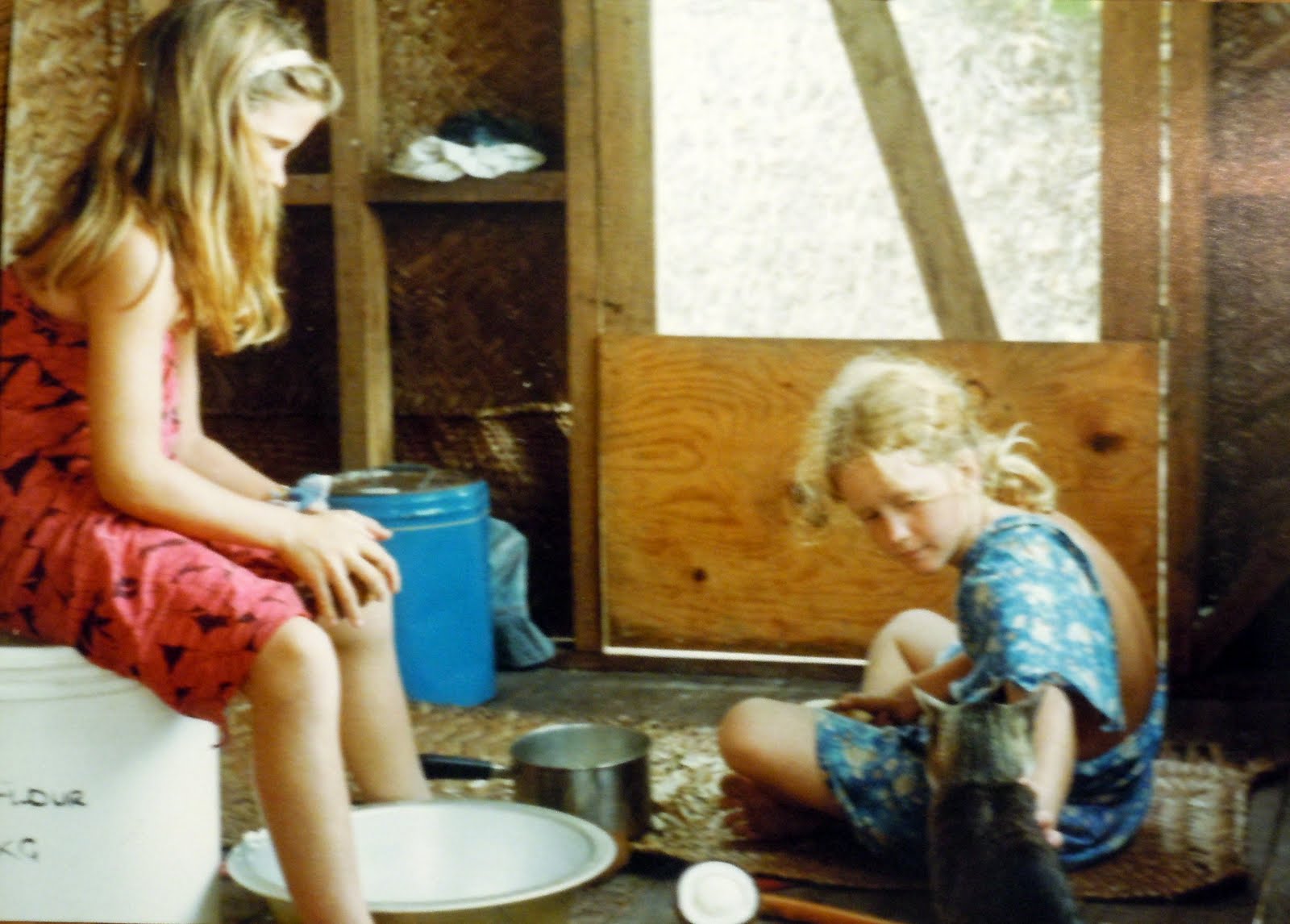
One morning a brown face appeared at our door. It peered in, eye-level with our floor on its stilts, taking in the strange, magical world of the foreign family. I was lying on my stomach on the opposite side of the veranda with my math papers spread around me and absently poking bits of leaf through the floor board. I watched a piece flutter to the gravel below, like a tiny WWII bomber, shot down in flames of glory by a Japanese gunship ... and looked up to meet the curious eyes.

"Whadda-you want?" I asked in Pijin, bored, but willing to take any diversion over my schoolwork. Village kids often came to our door, sometimes just out of boredom to stare at us. Other times they would bring requests for assistance, or gifts from their families; a plate of succulent fish heads with the blank, opaque eyes that stared up at you, some taro pudding that looked like blocks of poo on the plate, or even the occasional chicken egg to sell. Some of which actually had yolks instead of fetuses when you cracked them open.

"Come and see, my cat had kittens and this one is for you," the urchin responded, and over the floorboards poked a little pointed face, with a white patch surrounding its pink nose, sleepy blue kitten eyes, and little bumps of ears.

"Oh!" I cried, and scurried over to cuddle the little fur ball to my chest. "Thank you!" The child grinned at me and settled down on our steps to watch the rest of the kelaipa (white) family's reaction to his gift.

We decided the kitten's name over dinner. Our veranda was too narrow to afford enough moving room during the day with a table down the middle of it, so my dad had rigged up a large sheet of laminated plywood, which he attached with hinges to the wall. During the day it folded flush against the wall, held by a swing hook, and at meal times we suspended it with a rope on the free side, like a drawbridge. We squeezed in around it on flour and rice buckets to pounce on whatever food my mother had managed to cook up. "Vultures!" she would scold, as we all jockeyed with our plates for the first spoon full as soon as the last 'amen' was said.

"I think we should call it Jimbo," Matthew said. I looked indulgently at my littlest brother, but immediately gave the suggestion a mental veto. 'Jim' was the name of one of our cousins back home, and Matthew had already named one cat after him.

"I think we should name it after something in Austin," Anna said thoughtfully.

"How about Austin?" was the next inevitable remark. Lame. I looked to my dad for help.

"Well, what are our favorite things to do in Austin?" Mom prodded. Ideas were thrown out:

"The park!"

"Grandaddy's house."

"No, stupid, Grandaddy lives in Houston."

"Don't call your sister stupid, Nathan."

"What's Austin?" (this was from Matthew, the youngest, who had already forgotten everything except for his current world of palm trees and smiling, butt-naked friends).

"How about Barton Springs?" Dad suggested, seeing the conversation was in danger of getting completely derailed. "There's also Barton Creek, and Barton Springs Road..."

And so we decided to dub the cat 'Barton', in honor of our home town. Barton grew into sleek adulthood and gained his place in family lore as the stupidest cat we ever kept. He would lay in the very middle of the main breezeway through the house, and get his tail stepped on at least once a day, whereupon he would yowl and swipe at the owner of the offending foot, and get kicked out the front door for his pains. He feasted on canned tuna every night, which we secretly fed to him in the dark, after the danger of watching village eyes was over - it was considered supreme wastefulness that bordered on sacrilege to feed an animal anything but the very last scrapings of table scraps. And even table scraps were better given to the pigs or the chickens, who at least served a purpose and could be eventually eaten in return.

Barton was particularly hated by my Dad, who generally hates all cats on principle, but was tolerated because he kept the mouse population under control. He was our cat until we went on furlough a few years later. Upon returning to the village after our re-Americanization, he had disappeared, gone to the place that village animals go to after their short, stark lives. But for a brief time of glory, Barton was the better fed and kept than any cat (and probably most kids) in Luaniua village.